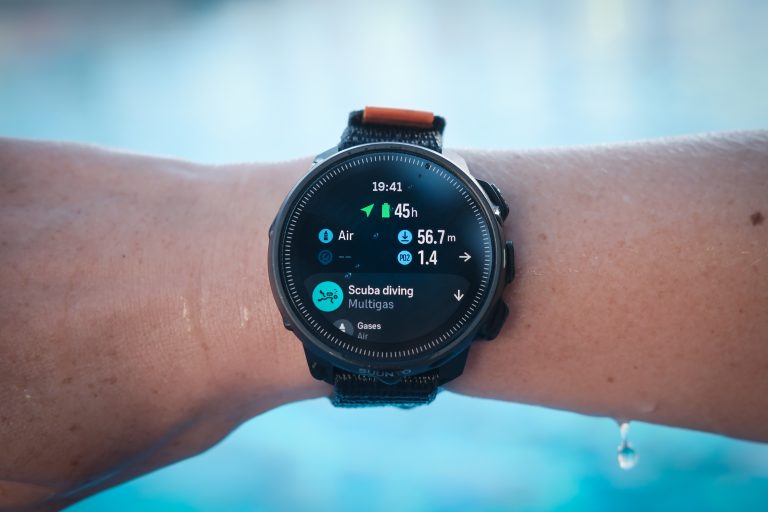
There’s a good chance your dive computer is using the Bühlmann algorithm to calculate your decompression. It’s celebrating its 40th birthday this year and has become the de facto standard in modern dive computers. Shearwater, Garmin, Scubapro, and latterly even Suunto all use this trusted model.
One of its benefits is its flexibility: using customisable gradient factors, the algorithm can be tweaked to suit the diver. On basic computers this may be through a simple conservatism setting, but on more advanced models you have full control to adjust the decompression model you’re using.
Gradient factors are a powerful tool. There’s lots of information online, and some of it is conflicting. So what are gradient factors, and how do they impact your decompression?
Decompression Basics
All decompression models aim to predict the intake and elimination of inert gases, particularly nitrogen, in the body. The ultimate goal is to control bubble formation and reduce the risk of decompression sickness (DCS). The models originally took the form of decompression tables and later evolved into the software (algorithms) of dive computers. They are both based on mathematical calculations using depth, time, and surface interval to predict how long a diver can stay at a given depth.
The first recognised decompression tables were created by the Scottish scientist John Haldane in 1908. Haldane’s model assumed that different tissues absorb and release nitrogen at different rates based on a half-life (i.e. exponentially). To simplify the calculations, the body is broken down into representative tissue groups, or “compartments”, of which Haldane’s original model had five.
Haldane’s model has been developed and iterated upon, but remains the conceptual underpinning of nearly all decompression models and algorithms used today. The Swiss physiologist Dr Albert Bühlmann, whose research began in the 1960s, developed the ZHL-16 model that is the de facto standard in dive computers today.
All decompression models are attempting to predict complex processes inside the body, and none are 100% effective. There are numerous examples of divers getting DCS while diving well within the limits prescribed by their computers. It must be remembered that decompression modelling is still an inexact science.
Decompression in Detail
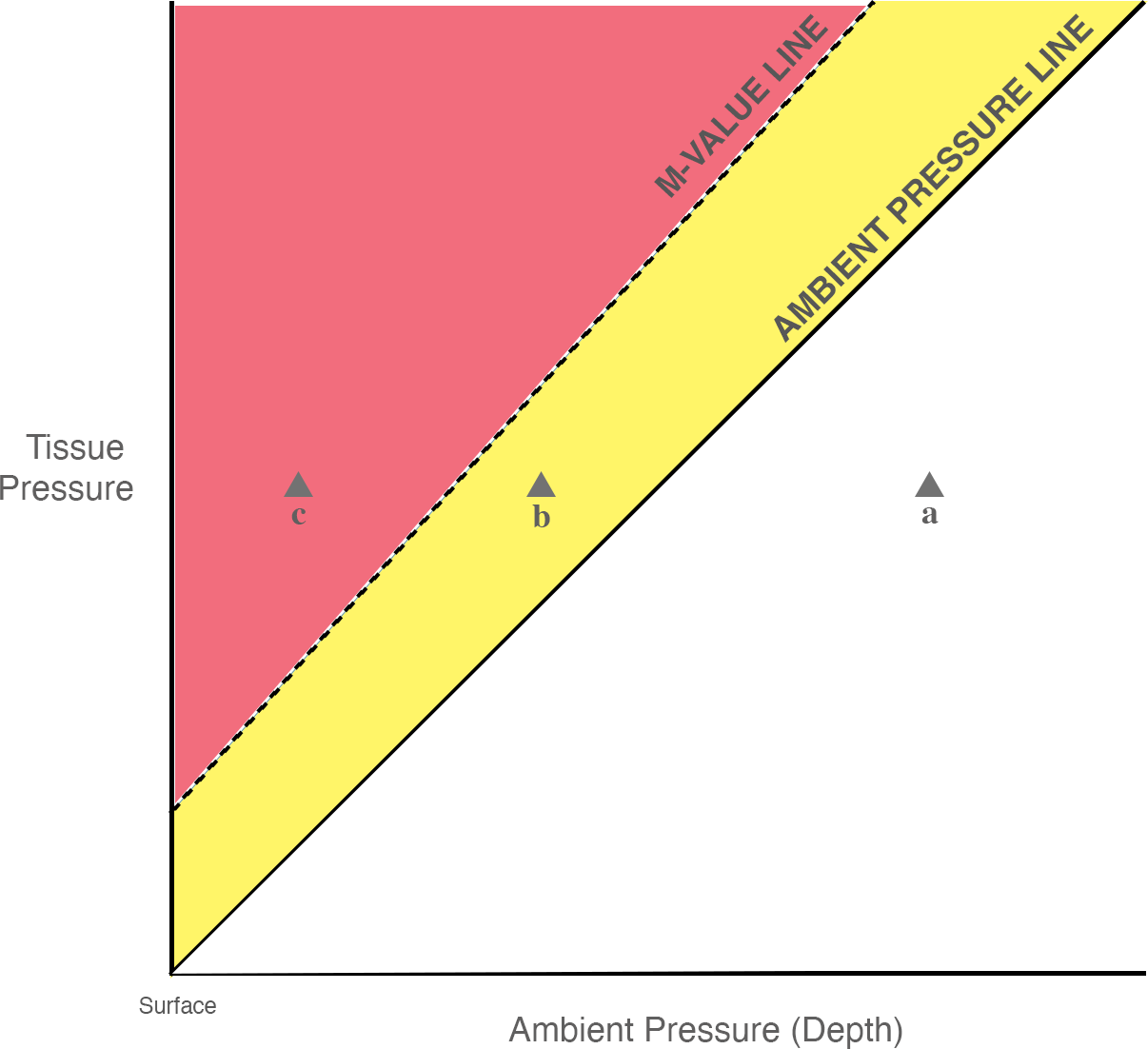
To understand what your dive computer, and its algorithm, are really doing during a dive we have to look into the detail. The graph below can be used to visualise the various stages of a dive, in this example a dive using air. It plots inert gas tissue pressure for a theoretical tissue compartment against depth, and can be used to illustrate the calculations of a decompression algorithm.
There are a couple of important terms to understand:
Tissue Pressure. As this example is an air dive, the inert gas is nitrogen. Tissue pressure is analogous to the quantity of nitrogen absorbed into the body.
Ambient Pressure Line. This describes when a tissue compartment’s pressure equals the ambient pressure for that depth, i.e. it is saturated with nitrogen. If a diver descended to point A, below the ambient pressure line, they start absorbing nitrogen as the ambient pressure is higher than the tissue pressure and can be described as ‘on-gassing’.
Supersaturation. Is the point at which a tissue compartment’s pressure is higher than the ambient pressure. This is the mechanism by which nitrogen is released from the body during the ascent of a dive. On the graph, both point B and C are both above the ambient pressure line and in a state of supersaturation. During this state tissue compartments can be described as ‘off-gassing’.
M-Value Line. Decompression algorithms principle goal is to allow the safe elimination of nitrogen from the body. The M-Value line is the limit, as expressed by the algorithm, that this can happen safely. If the gas pressure of a tissue compartment was to rise too far above ambient pressure (depth) then large bubbles and DCS is likely to occur. The gradient of this line is unique to each different decompression algorithm. point C on the graph is above the M-value line and in a dangerous state of supersaturation, with damaging bubble formation likely.
Now we can look at the various stages of a decompression dive:

A diver has completed a dive and is ready to leave the bottom to begin their ascent. The theoretical tissue compartment is at point A.
As the diver ascends, moving from point A to point B, they continue to absorb nitrogen until they cross the ambient pressure line. In the yellow section of the graph, the diver is in a state of supersaturation and is safely removing nitrogen from their body.
At point B, the diver cannot ascend any further without crossing the M-value line and exposing themselves to DCS. This is the first of the three decompression stops. Each stop allows nitrogen to be released while the depth is kept constant. The tissue pressure now reduces towards the ambient pressure line. Once it has reduced enough, the diver can ascend to the next stop and repeat the process.
On completing the dive, the diver exits the water at point C, with their tissue pressure still significantly higher than ambient surface pressure but below the M-value line. A dive computer would continue this calculation from point C during the surface interval before diving again.
In this simplified example, we looked at a single imaginary tissue compartment. The Bühlmann algorithm uses 16 different tissue compartments, all with different rates of nitrogen absorption and elimination.
Gradient Factors
In simple terms, gradient factors are a safety margin that can be applied to certain decompression algorithms, chiefly Bühlmann’s, with the aim of reducing the risk of DCS.
On entry-level computers, this is normally shown as a conservatism level or safety factor that the user can select. On more advanced computers, popularised by manufacturers like Shearwater, it is shown as a combination of numbers, e.g. 30/70. However, to understand how gradient factors work and what those numbers are doing to the base algorithm, we again have to look into the detail.
To add a safety margin, gradient factors modify the algorithm to keep divers away from the M-value line. The extent of the safety margin applied is controlled by the two numbers mentioned above, referred to as Gradient Factor (GF) Low and Gradient Factor (GF) High. The example above, 30/70, refers to GF Low at 30% and GF High at 70%.
So, GF Low at 30% means the first decompression stop will be at 30% of the M-value limit, and GF High refers to the surfacing value, in this example 70% of M-value limit. It’s worth noting that GF Low only impacts decompression diving. This is illustrated below:

Throughout decompression, the diver is kept significantly below the M-value line, which reduces the level of supersaturation the tissue compartment is exposed to and potential for bubble formation.
Key observations
– As the gradient factors are not symmetrical, there is additional conservatism at the start of the decompression stops.
– This results in the first stop being significantly deeper than the base algorithm.
Gradient Factors: Comparisons
We can see the significant difference gradient factors can have on decompression with the two dive plans below: one using 95/95 and the other using 30/70.
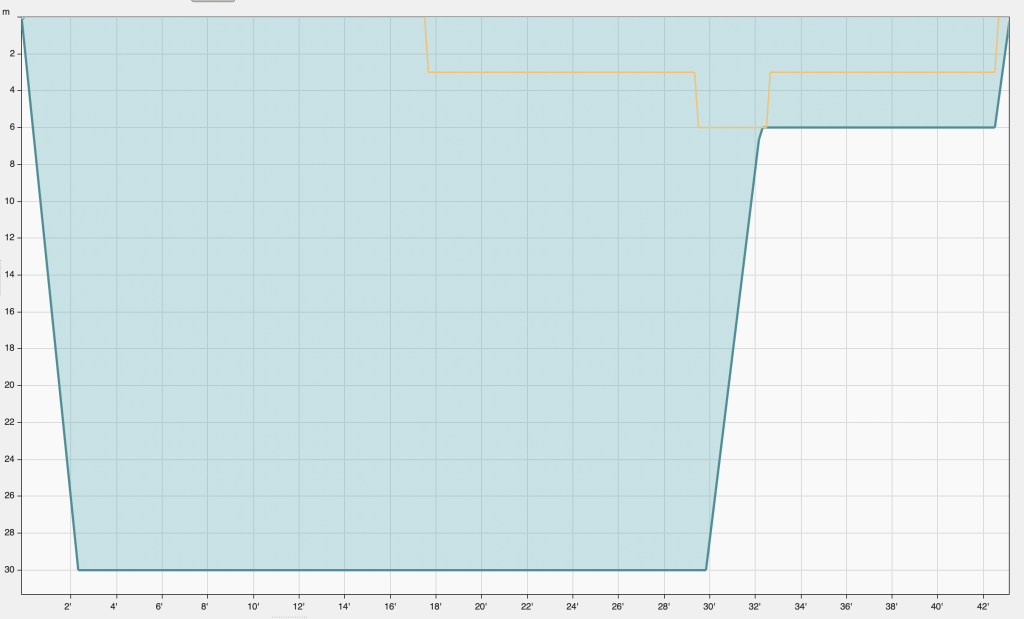

The dive using 30/70 requires an additional 25 minutes of decompression, with its first stop 3 m deeper, at 9 m.
Final Thoughts
There are plenty of good reasons you may want to add additional conservatism to your computer. Maybe you’re overweight (an acknowledged risk factor in DCS), or the dive is going to be particularly strenuous due to current.
The question of what gradient factors to select is nuanced. The GF High setting defines the level of tissue supersaturation on ending the dive and is closest to being a general “safety factor”. A lower value here will significantly reduce your no-decompression time or increase stop lengths.
As GF Low only applies to decompression stops, it is of less concern to recreational divers, given their exposure is usually limited to unplanned decompression. There is evidence to suggest that maintaining symmetrical gradient factors (e.g. 85/85) in air diving has benefits by reducing the depth of the initial decompression stops.
Deep stops were popularised by competing decompression models, such as the Reduced Gradient Bubble Model (RGBM), which theorised it was beneficial “to maintain the diver at depth to both crush bubbles and squeeze out the gas via diffusion…”.
However, recent studies suggest that any benefit from crushing and squeezing bubbles is negated by the reduced pressure gradient for off-gassing, and that some tissue compartments will still be on-gassing during deep stops. An experiment by the US Navy in 2011 found “that slower tissue gas washout or continued gas uptake offsets the benefits of reduced bubble growth at deep stops”.
Gradient factors have the power to fundamentally alter how your dive computer calculates decompression. If you’re brave and venture onto diving forums or subreddits there is plenty of advice on settings on offer, not all it helpful… My advice would be, unless you’re absolutely clear on the science, risks and potential benefits, not to touch them and stick to the default settings.
None of the information contained here is intended to replace formal training, and if in doubt, always stick to the manufacturer’s default settings.
Further Reading & References
Selecting Optimal Air Diving Gradient Factors for Belgian Military Divers: More Conservative Settings are Not Necessarily Safer – A useful study by the Belgian Navy investigating the application of gradient factors on Shearwater dive computers.
Redistribution of Decompression Stop Time from Shallow to Deep Stops Increases Incidence of Decompression Sickness in Air – A study by the US Navy comparing the incidence of DCS using deep and shallow decompression stops.
Gradient Factors (GF) and Dive Computers – Gradient factor guidance from CMAS